
Blog
The Self-Employed Person's Guide to Healthcare in South Carolina

When you work for yourself, health insurance becomes another business expense. Without an employer contributing toward premiums, healthcare costs can affect both household finances and business income.
For freelancers, independent contractors, and small business owners, choosing healthcare for the self-employed in South Carolina means balancing insurance premiums, deductibles, and access to medical services.
Traditional insurance provides protection against major medical expenses, while options like direct primary care can make routine healthcare costs more predictable.

Health Insurance Options for Self-Employed South Carolinians
Self-employed individuals generally purchase their own coverage unless they qualify through a spouse, another employer, or a government program.
ACA Marketplace Health Insurance
The Affordable Care Act Marketplace is a common starting point for self-employed health insurance in South Carolina.
Through HealthCare.gov, eligible individuals can compare plans covering essential health benefits, including hospitalization, emergency services, prescriptions, and preventive care. Marketplace plans are organized into Bronze, Silver, Gold, and Platinum categories. Bronze plans generally have lower premiums but higher out-of-pocket expenses. Gold and Platinum plans typically have higher premiums but cover a larger share of eligible costs.
Plan selection should account for expected medical needs, prescription coverage, and provider networks.
COBRA Coverage
Individuals leaving traditional employment may qualify for COBRA continuation coverage. COBRA allows eligible workers to temporarily retain their former employer's health plan, which may be useful when continuing treatment with existing providers.
However, individuals generally pay the full premium, including the portion previously covered by the employer, plus a permitted administrative charge.
Short-Term Health Insurance
Short-term health insurance may provide temporary coverage during certain transitions, depending on current state and federal rules. These policies generally do not offer the same benefits or consumer protections as ACA-compliant plans and may exclude pre-existing conditions, prescriptions, or other services. Consumers should review eligibility, coverage exclusions, and policy limitations carefully before enrolling.
Understanding Healthcare Costs Without Employer Coverage
Self-employed workers must consider premiums alongside deductibles, copayments, and other out-of-pocket expenses.
For example, an individual paying $600 monthly spends $7,200 annually on premiums alone. A family paying $1,700 monthly spends $20,400 annually.
For people with fluctuating business income, fixed healthcare expenses can complicate budgeting. Comparing total annual costs provides a more useful picture than evaluating premiums alone.
These figures are illustrative rather than verified South Carolina averages.
How ACA Subsidies Affect Self-Employed Workers
Marketplace premium tax credits can reduce insurance costs for eligible households. Eligibility depends on income, household size, access to other qualifying coverage, and applicable federal rules.
For 2026, enhanced premium tax credits from earlier years have expired. Standard eligibility generally applies to households earning between 100% and 400% of the federal poverty level, subject to other requirements.
HealthCare.gov's premium tax credit guidance explains how income affects eligibility.
Income Changes and Tax Credits
Marketplace subsidies are calculated using estimated annual household income. For freelancers with variable earnings, actual income may differ substantially from the original estimate. If earnings increase, some advance premium tax credits may need to be repaid when filing taxes.
Updating Marketplace income estimates throughout the year can help reduce unexpected adjustments.
Subsidies also do not eliminate deductibles, coinsurance, or provider-network restrictions.
Tax Deductions for Self-Employed Health Insurance
Many qualifying self-employed individuals can deduct eligible health insurance premiums when calculating federal adjusted gross income. The deduction may apply to coverage for the business owner, spouse, and eligible dependents.
According to the IRS instructions for Form 7206, eligibility depends on business income and access to employer-subsidized coverage.
Generally, the deduction cannot exceed qualifying earned income from the business. It may also be unavailable for months when the individual is eligible for certain employer-subsidized health plans, including coverage through a spouse. The deduction generally reduces income tax rather than self-employment tax.
Because it can interact with Marketplace premium tax credits, business owners may benefit from professional tax guidance.
How Direct Primary Care Works for Self-Employed Individuals
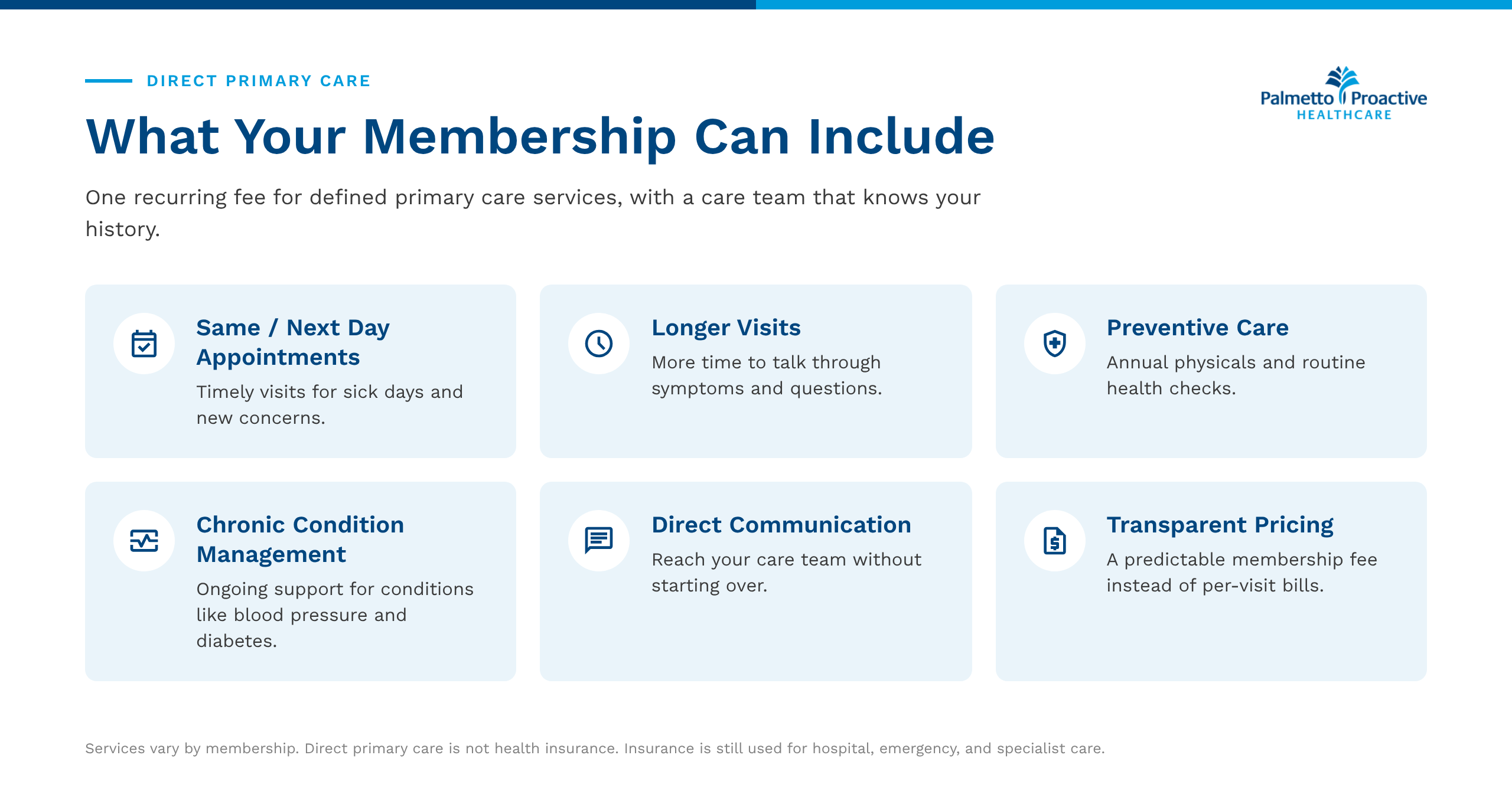
Direct primary care (DPC) uses a membership model rather than traditional insurance billing for covered primary care services.
Patients pay a recurring fee for access to defined services, which may include preventive visits, sick appointments, chronic condition management, and direct communication with their care team. This arrangement can make routine healthcare expenses more predictable for freelancers and independent contractors.
What DPC Does Not Cover
Direct primary care is not comprehensive health insurance. Membership generally does not cover hospitalization, emergency treatment, specialist services, or every diagnostic procedure.
Patients may continue using insurance for medical needs outside their membership.
Combining DPC With Major Medical Coverage
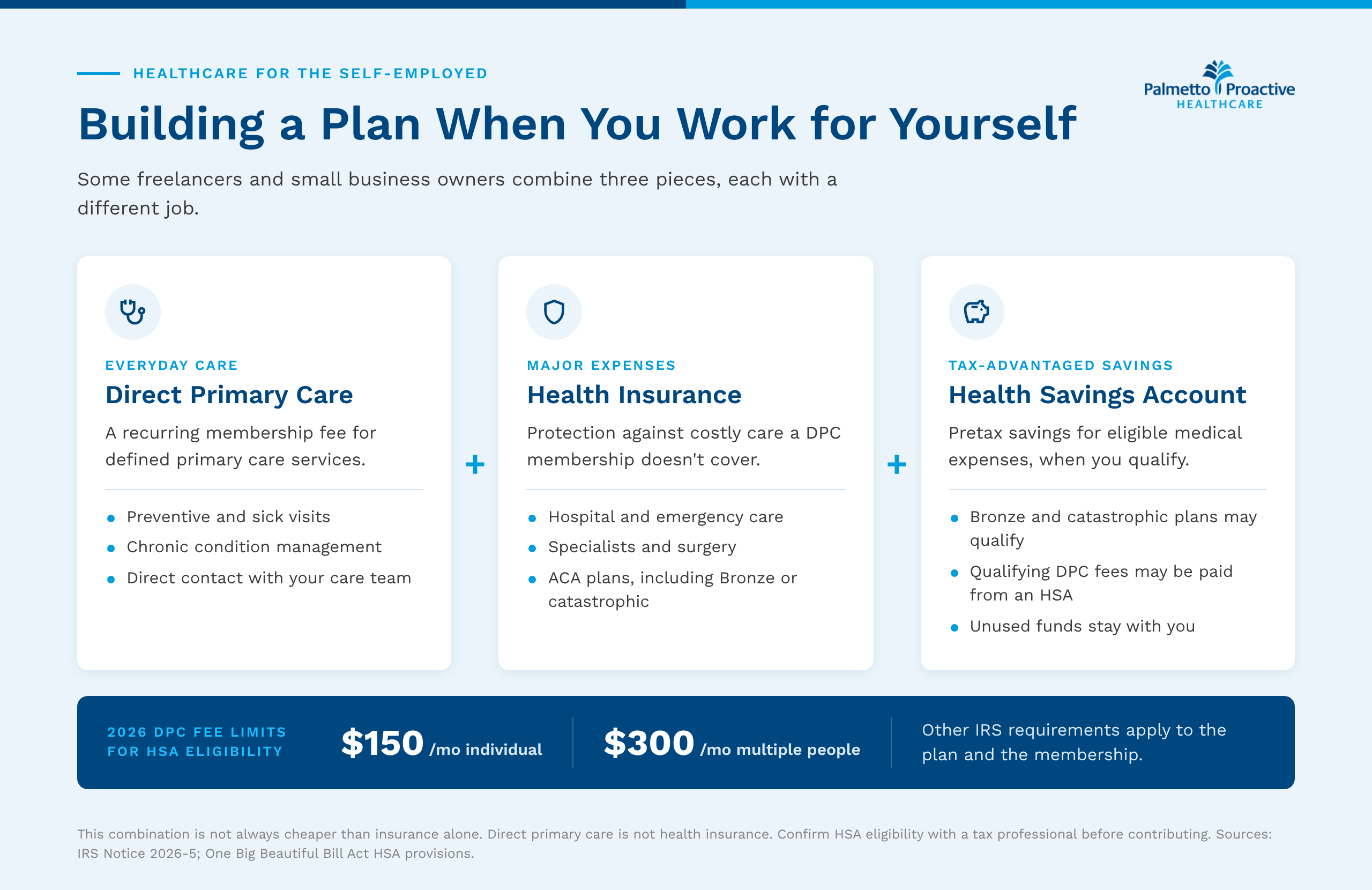
Some self-employed individuals combine DPC membership with insurance that protects against substantial medical expenses.
This approach separates routine care expenses from protection against hospitalization, surgery, and other costly services. However, the combination is not always cheaper than traditional insurance alone.
Shopping and comparing options on what you get versus what you need can provide a better picture.
Catastrophic Health Insurance
Catastrophic health insurance plans generally have lower premiums and higher deductibles. They cover essential health benefits and provide protection against qualifying major medical expenses, although eligibility and availability depend on current rules and local plan offerings. HealthCare.gov's catastrophic plan guidance explains the requirements.
For some households, a subsidized Bronze or Silver plan may offer better overall value. Before combining catastrophic coverage with direct primary care, compare the total cost of premiums, membership fees, deductibles, and provider-network limitations.

New HSA Rules for Direct Primary Care in 2026
Federal changes effective January 1, 2026, expanded Health Savings Account eligibility for certain direct primary care arrangements.
Previously, many DPC memberships could interfere with eligibility to contribute to an HSA.
The IRS guidance on expanded HSA benefits explains how qualifying DPC arrangements may now work alongside HSA eligibility.
DPC Membership Limits
For 2026, qualifying DPC arrangements generally must charge no more than:
-
$150 monthly for individual coverage
-
$300 monthly for arrangements covering multiple people
Additional requirements apply to covered services and membership structure.
Under the updated rules, certain direct primary care membership fees may qualify for tax-free payment from an HSA. However, whether an individual can contribute to an HSA depends on their overall coverage, the DPC arrangement, and other IRS eligibility requirements.
HSA Eligibility With Bronze and Catastrophic Plans
Beginning in 2026, qualifying Bronze and catastrophic health plans are also treated as HSA-compatible under expanded federal rules.
This creates additional options for self-employed individuals combining major medical coverage, direct primary care, and tax-advantaged savings. However, other disqualifying coverage may still affect eligibility.
Confirm that both the insurance plan and DPC arrangement meet current IRS requirements before making HSA contributions.

Choosing Healthcare Based on Your Financial Needs
The best healthcare arrangement depends on household income, medical needs, and expected expenses.
When comparing options, consider:
-
Annual premiums after applicable subsidies
-
Deductibles and maximum out-of-pocket exposure
-
Prescription and specialist coverage
-
Access to preferred physicians
-
Routine primary care expenses
-
DPC membership costs
-
Available tax deductions and HSA benefits
Someone managing a chronic condition may prioritize regular physician access, while a healthy freelancer may focus on protection against unexpected major expenses.
Families should also account for pediatric care, prescriptions, and coverage for multiple household members.
Building a Healthcare Plan That Fits Self-Employment
Healthcare planning for self-employed individuals involves balancing routine medical expenses with protection against unexpected costs. Health insurance, direct primary care, and tax-advantaged savings can serve different purposes, depending on household income, medical needs, and budget.
For freelancers, independent contractors, and small business owners in South Carolina, Palmetto Proactive offers an alternative approach to everyday healthcare through its individual direct primary care membership.
Explore Palmetto Proactive's membership options to see how direct primary care could fit into your healthcare plan.